Master's Thesis Project · HCI, Cal State East Bay| Jan–May 2025
Designing CarePal: An Empathetic Wearable Ecosystem for Elder Care
A dual-band hardware and mobile app system designed to transform medication adherence into a shared ritual of connection for elderly users and caregivers ( family members).
✿ Context: Master's Thesis HCI (CSU East Bay - Interaction Design)
✿ Duration: Jan 2025 – May 2025
✿ My Role: Product Designer & Creative Technologist (Mobile UI Design & Arduino Engineering)
✿ Platforms: IoT Wearable (Arduino Nano) & Native Mobile App
✿ Scope: Hardware Engineering (BLE Sync) and UI/UX Design.
✿ Tools & Workflow:
♡ Software code:
♡ Hardware & IoT: Arduino Nano, Bluetooth Low Energy (BLE), haptic motors, and LEDs.
♡ UI/UX Design:
♡ Research Workflow: Semi-structured interviews, physical prototyping, and usability testing.
✿ Ai Workflow:


What if a reminder could feel like care, not pressure?
Project Overview
✿ The Product: An IoT wearable and a companion native mobile app.
✿ The Mission: Transforming medication adherence into a shared ritual of emotional connection.
✿ The Mechanism: Using "Calm Technology" (gentle haptics and LEDs) to bridge physical distance.

The Problem Statement
✿ Standard pill dispensers make elderly users feel heavily monitored.
✿ Constant worry leads to high-stress, relationship-straining caregiver check-ins.
✿ Complex medical apps disrupt the comfortable daily routines of older adults.
Most solutions focus on tracking, not emotional support or user comfort

Supporting seniors requires going beyond the pill to foster mobility, social vitality, and holistic health
Problem
The Problem (Friction)
✿ Jarring auditory medical alarms cause stress and cognitive overload.
✿ Negative "missed dose" alerts make users feel monitored and punished.
✿Smart dispensers force users to abandon their comfortable daily routines.
✿ Caregiving often falls on a single, overwhelmed family member.
Solution
Novelty of CarePal as a Solution
-✿ Time vibration confirmations are sent to the caregiver.
✿ Replaced with gentle, peripheral haptic vibrations and soft LEDs.
✿ A screen-free wristband that seamlessly accommodates any medication type.
✿ A shared app ecosystem that allows multiple family members to reconnect and participate in the care loop.
The Core Goal
✿ We’ve all watched a loved one struggle with isolation and health from afar.
✿ Elderly users need more than just a medication alarm; they need a sign that someone cares.
✿ CarePal was built to turn cold, clinical reminders into soft, human moments of connection.

The Competitive Landscape
Smart Dispensers
(e.g., Hero, MedMinder)

Stationary and overly clinical, prioritizing mechanical compliance over human connection.
Mainstream Wearables
(e.g., Apple Watch, Fitbit)

Over-featured and overwhelming for seniors, lacking a dedicated feedback loop for caregivers.
Smartphone Apps
(e.g., Medisafe, MyMeds)

High-friction and easily ignored, demanding high tech-literacy while feeling emotionally cold.
Companion Tech
(e.g., Paro, ElliQ)

Emotionally soothing but functionally passive, failing to actively support critical daily health routines.
The Research
Discovery & Generative Research
4-week generative sprint with 24 participants (12 seniors, 12 remote caregivers).
The Method
Contextual inquiries and emotional journey mapping.
The Pivot
Redefining elder care by replacing clinical monitoring with empathetic, human-centered reassurance.
Ideation & Concept Evolution
✿ Initial Hypothesis: Automate pill dispensing to solve elderly forgetfulness.
✿ The Problem: Research revealed a 50% non-adherence rate in complex medication regimens.
✿ The Emotional Discovery: Caregivers face an "anxiety burden" equal to the patient’s physical challenge.
✿ The Strategic Pivot: Shifted focus from functional compliance to emotional connection.
✿ The Solution: A dual-wearable ecosystem (wristbands) providing real-time mutual reassurance.


Design process

Specific Design Choices for the Wristband
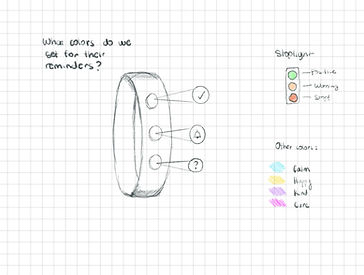
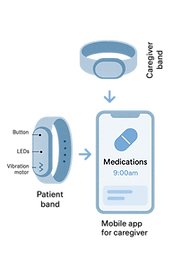
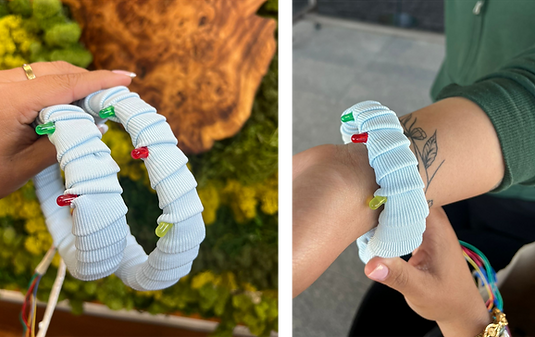
We engineered an accessible, screen-free interface featuring a single low-dexterity button, gentle haptic vibrations, and intuitive color-coded LEDs.
✿ A simple button press provides instant, real-time reassurance to caregivers.
✿ All medication formats without disrupting existing daily habits.
✿ Replaces "clinical nagging" with a holistic, mobility-focused routine.
Prototyping & Hardware Calibration

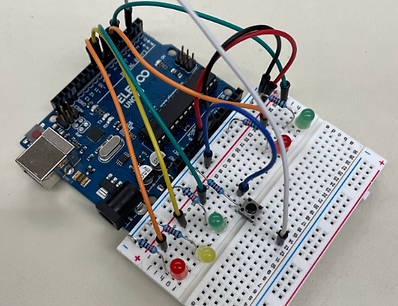


✿ Microcontroller Prototyping:
Built functional units using Arduino Nano, haptic motors, and multi-state LED modules.
✿ Real-Time BLE Sync:
Programmed custom Bluetooth Low Energy logic for latency-free communication between bands and the smartphone hub.
✿ Power Optimization:
Architected firmware sleep-modes to maximize battery life for reliable 24-hour daily wear.
System Architecture & Engineering
Interaction & Interface Design
✿ Accessible Hardware:
Engineered an oversized, single-button interface for users with arthritis or limited dexterity.
✿ Multi-Sensory Feedback:
Replaced jarring alarms with "Calm Tech" haptics and warm LEDs to reduce cognitive overload.
✿ Glanceable Caregiver UI:
Designed a zero-interaction display using universal color codes for instant, passive status updates.

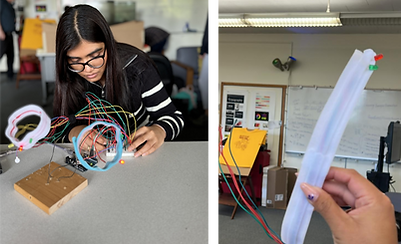


The Final Hardware Prototype
Translating calm technology principles into a fully functional, BLE-synced physical wearable.

Information Architecture


The App Build
Onboarding & Configuration
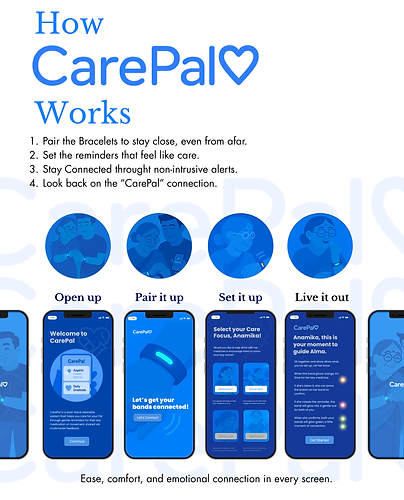
✿ Relational Onboarding:
Tailors the app’s emotional tone and interface based on the specific caregiver-patient dynamic.
✿ Guided Pairing:
Uses step-by-step visual cues to ensure seamless Bluetooth connectivity between wristbands.
✿ Customizable Focus:
Allows caregivers to toggle tracking for medication, physical movement, or a hybrid of both.

Monitoring & Care Management
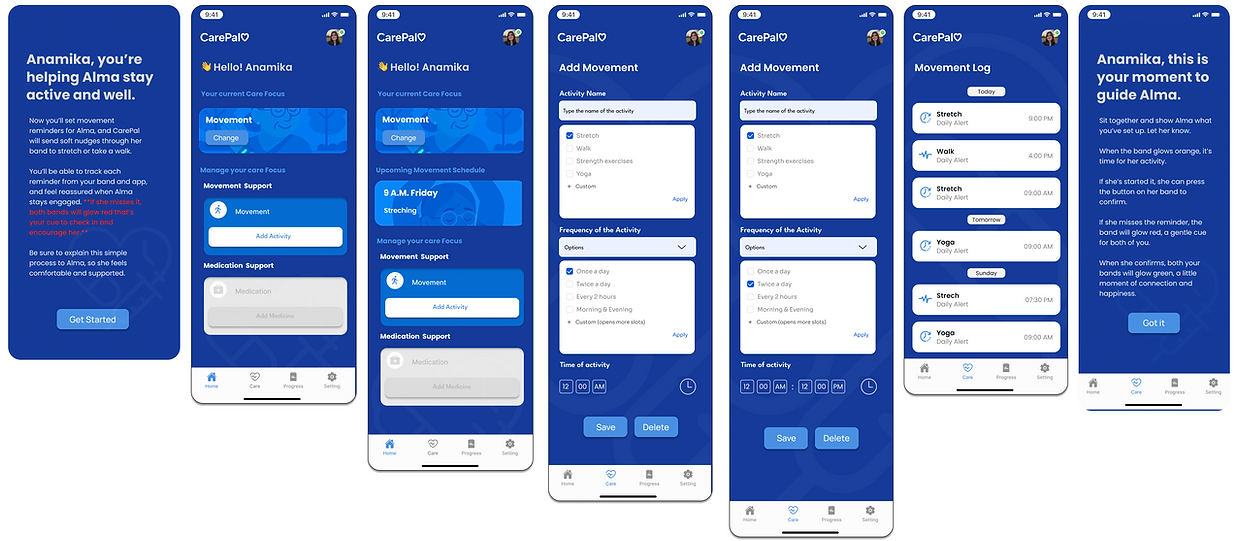
✿ Intuitive Scheduling:
Simplifies the input of complex medication regimens and daily health activities.
✿ Real-Time Dashboard:
Features color-coded status updates that sync instantly with the patient’s hardware.
✿ Clinical Exporting:
Generates historical adherence and mobility reports to share directly with healthcare providers.
✿ Accessible UI:
Employs large tap targets and "Calm Tech" notification limits to prevent caregiver burnout.

Adherence Tracker (Medicine)
Activity Monitor (Movement)

User Testing: Testing the Ecosystem
We conducted usability sprints with 6 senior-caregiver pairs to refine the physical ergonomics and digital clarity of the entire system.
The Wearable (Hardware)
✿ The Friction: "Soft-touch" buttons left users unsure whether their presses were registered.
♡ The Fix: Engineered a mechanical "click" for clear, tactile confirmation.
✿ The Friction: Early haptic alerts were described as "startling" or "anxiety-inducing."
♡ The Fix: Recalibrated to a "gradual pulse" that nudges the user gently.
✿ The Friction: LED prompts were difficult to see in high ambient sunlight.
♡ The Fix: Redesigned the housing for a high-contrast "deep glow" effect.
✿ The Friction: Silicone bands caused skin irritation during 24-hour sleep/wake cycles.
♡ The Fix: Pivoted to breathable, medical-grade velcro for all-day comfort.
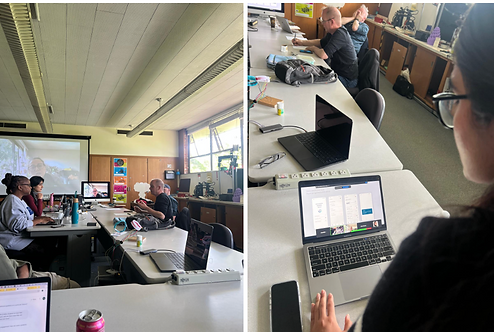
We conducted remote moderated testing with 12 caregivers to ensure the interface reduced "cognitive load" rather than adding to the stress of caregiving.
Digital Validation: App Iteration
✿ The Friction: Users found the medication input "too clinical" and overwhelming.
♡ The Fix: Simplified the setup into a conversational, relational onboarding flow.
✿ The Friction: Small buttons were difficult to tap during busy, high-stress moments.
♡ The Fix: Increased all primary action targets to a minimum 48dp hit area.
✿ The Friction: Too many minor alerts led to "notification fatigue" and anxiety.
♡ The Fix: Implemented "smart snoozing" to prioritize only critical missed windows.
✿ The Friction: Caregivers had to tap multiple times just to see if the patient was okay.
♡ The Fix: Redesigned the home screen for a "zero-tap" glanceable dashboard.
Future Iterations

1
2
me on a video call with my grandmother :)

Personal Reflections
♡ My background in the fashion business taught me that wearables are an extension of identity; if it doesn’t feel good to wear, it won’t be used.
♡ Testing with seniors reminded me that "accessibility" isn't a checklist; it’s the dignity of being able to press a button without help.
♡ I realized that the goal wasn't just "medical tracking," but replacing long distance anxiety with a silent, steady pulse of reassurance.


Other Case Studies